Monday, July 26, 2010

Editorial Assignment


What do you consider to be California's most pressing issue? Jobs? Real estate costs? Partisan politics? Transportation? Immigration? Public employee pensions? Crumbling infrastructure? Education funding? Prisons? In an editorial, illustrate 1) what you consider to be the state's most significant problem and 2) your argument as to why this should be one of the state's top priorities. You do not have to provide a solution for the problem per se, but you must stress the urgency of the issue you choose. In other words, why should California focus its resources on this problem? What will be the consequences of ignoring the issue? Cite evidence from the articles we read this week to support your thesis.


Requirements:
  • MLA format, including parenthetical citation
  • 2.5-page minimum
  • Cite at least three articles

    The best papers:
    • Stay within the parameters of the subject matter
    • Have a concise thesis which clearly outlines a position
    • Clearly support the thesis with solid evidence and a logical structure, citing at least three articles from the reader
    • Cite a minimum of three articles to support the thesis
    • Conclude with a summation of the argument
    • Properly cite evidence using MLA's parenthetical citation method
    • Are in compliance with MLA Style

      Sample editorials:

        Due: Wednesday, July 28th

        Sunday, July 25, 2010

        Week Eight: Lodi


        The Lodi Mission Arch


        Just about a year ago,
        I set out on the road,
        seeking my fame and fortune.
        Looking for a pot of gold.
        Things got bad, and things got worse,
        I guess you will know the tune.
        Oh Lord, stuck in Lodi again.

        —Creedence Clearwater Revival, "Lodi"

        Week 8
        M 7.26
        READ
        eR: “California: Ruined by the Supermajority” by Joe Matthews, “What’s the Matter with California?” by Robery Mackey and Liz Robbins, “Silicon Valley Loses Best-Workplace Luster After Job, Pay Cuts” by Ryan Flinn, “Fortune 500’s Flee California” by Michelle Steel, "California' Rebound Forecast to Lag Behind Nation's" by Alana Semuels

        IN-CLASS
        Reading discussion, Presentations; Preview—Editorial essay

        DUE
        Persuasive essay (Attach first and second drafts)

        W 7.28
        READ
        eR: “The California Quagmire” by Karl Manheim, John S. Caragozian, and Don Warner, “Is Marijuana the Answer to California’s Budget Woes?” by Tom McNichol, "Cracks in the Future" by Bob Herbert, 'Why California is Still America's Future" by Michael Grunwald, “Californians Pessimistic about Future” from AirTalk, KPCV (audio program)

        IN-CLASS
        Writers workshop, Presentations

        DUE
        Editorial essay
        ; Research paper (Bring 3 copies of the first 2 pages of your paper)

        UPCOMING:

        Week 9

        M 8.2
        READ
        MC: “Transients in Paradise” by Aimee Lu, “The Last Little Beach Town” by Edward Humes, “Bienvenidos a Newport Beach” by Firoozeh Dumas, “Berkeley” by Michael Chabon, “The Line” by Ruben Martinez, “Flirting with Urbanismo” by Patt Morrison, “My Little Saigon” by Ahn Do, “The Nicest Person in San Francisco” by Derek Powaze, “The Un-California” by Daniel Weintraub; MANY: “Los Angles Notebook” by Joan Didion, “Wildflowers” by David Mas Masumoto; eR: “What is San Francisco?” by Herb Caen, “Pink Elephant Hunting” by Gary Singh

        IN-CLASS
        Reading discussion; Presentations; Preview—Personal essay

        DUE
        Annotated bibliography


        W 8.4
        IN-CLASS
        Personal essay; Writers workshop

        DUE
        Research paper, pages 1-4 (Bring 3 copies)

        Tuesday, July 20, 2010

        Survey: Facebook Near the Bottom of the Customer Satisfaction Barrel

        By Chris Gentilviso, Time
        07.20.10

        New research shows that, in addition to likes, the social networking giant has secured its share of eye rolls.

        Despite approaching half a billion users, the American Customer Satisfaction Index finds that Facebook isn't necessarily on friendly terms with all of its inhabitants. PC World got its hands on the survey numbers, which have the online fad in the bottom five percent of companies analyzed for their ability to procure user gratification. Facebook stands alongside the usual hair-pulling suspects -- airlines, cable companies, and tax-season helpers.

        So what are the reasons for the downfall? Privacy, perhaps. Bloomberg News spoke with a sponsor of the ACSI's survey, Larry Freed, who cites older users as a potential peg behind the lower satisfaction score. While that demographic is growing for the site, it's a sect that may not be smiling at the company's frequent security changes and updates.

        Monday, July 19, 2010

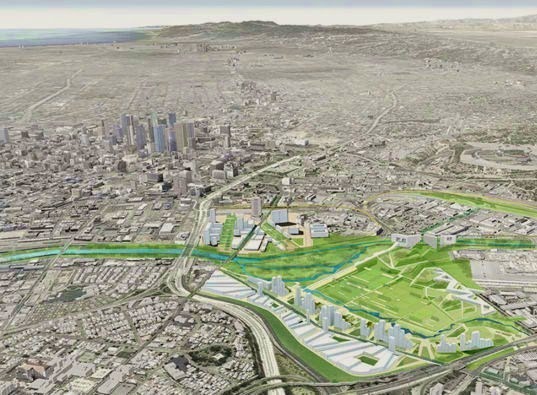
        Environmentalists Dream of Park Space Along Los Angeles River


        Earlier this month federal regulators named the Los Angeles River a navigable waterway. That's given advocates for its restoration new hope for new projects. Here's more about one group's dream park near downtown Los Angeles.

        By Molly Peterson, KPCC 
        July 19, 2010

        From the roof of the sheriff's garage near downtown Los Angeles, the twin towers correctional facility is right next door. Dodger Stadium is visible, and as Lewis McAdams points out, "There's USC Medical Center on the east. There's Santa Fe brewery, the Metro maintenance facility. This is the only place people can actually see the Piggyback Yard."

        From this roof the Los Angeles River looks like a river. There's green algae along the bottom of it, red where metals are mixing in with it. The river is sort of hemmed in right now not only by the concrete but by rail tracks on either side of it.

        A train horn at the Union Pacific Transfer Yard sounds.

        I took in the rooftop view with Lewis McAdams of the Friends of the Los Angeles River. He wants to stoke excitement about a new park in central L.A. "What we set out to do was look at this railroad yard, which is over a hundred years old, which is the epitome of the industrial-era use of the river, which is basically a conveyance of goods and products... and imagine what this could become," McAdams says. "Its a chance, in a sense, to sculpt the future with water."

        A team of architects working with McAdams dreamed up dramatic changes for the L.A. River near this stretch – either diverting part of it onto spreading wetlands, or removing the east side of the river's concrete channel so that the water can meander. The project's hydraulic technical adviser, Ira Artz, says detaining some water on site would protect homes downriver from a major flood. "It actually reduces the amount of water that would otherwise go downstream in the channel and allows you to do more things with that channel. It shows what you can do by breaking out the channel, and that's very significant to both the Corps of Engineers, the county of Los Angeles and the city of Los Angeles," Artz says.

        Artz would know – he worked on the city-funded, $3 million L.A. River Revitalization Master Plan. That plan, says Leigh Christy from the architecture firm Perkins and Will, underpins Piggyback Yard.

        Christy says making a park people could get to on foot, on bikes or on rail lines could connect divergent neighborhoods. "Its very near downtown Los Angeles, very near where high speed rail is coming in," she says, "walking distance to Union Station, there are multiple things happening in this corridor right now. So there were a lot of opportunities to connect to transportation, to communities, to things like that."

        Christy's firm and three others met for eight months to conceptualize the park. Jessica Varner, an associate at Michael Maltzan Architecture, says their sketches were no holds barred.

        Architect Mark Salette says they've sketched out trails, soccer fields and gardens along the river. "We described it as a vertical integration of the uses as opposed to the way the city has developed horizontally and experienced a lot of segregation. I don't mean just from a racial standpoint but also from a use standpoint," he continues, "you have residential areas and industrial areas and office areas."

        Here and nearby they'd mix together multifamily housing, an arts center, stores, offices and warehouses – a stark contrast to the rows of containers parked at the Union Pacific Transfer Yard now. Landscape architect Mia Lehrer points over in that direction. "You see those trucks coming in there with the containers on the back?"

        Lehrer says Union Pacific's way of using the property now inspires the dream park's name. "The containers, they put it on a gurney and they get hauled to wherever. So it's piggybacking the containers as they move from the port and out of here," she says.

        The designers say they targeted Union Pacific's yard because of its size. A spokesman for the railroad confirms the company met with the team, but stresses that the property is integral to moving containers out of the port and into the west.

        Architects Mark Salette and Leigh Christy admit that's an obstacle – but argue it may not be a permanent one. "This yard is starting to be too small for the type of trains they want to assemble and they're doing a lot of it further east," he says.

        Christy breaks in. "Of course they said the land is not for sale. But they said that with the Cornfield and Taylor Yard too, so we hold out hope," she says with a smile.

        Those two parks took tens of millions of dollars, years, statewide initiatives, legislative action, lawsuits, and the largest multi-ethnic, multi-organization, multi-agency effort ever in L.A.'s history to happen. For this park Friends of the Los Angeles River isn't releasing a proposed price tag.

        Lewis McAdams says he knows he's an idealist. He's also a poet. "The poet William Carlos Williams said a new world is a new mind. So that's what we're doing, is creating a new mind," McAdams says.
        This week he starts making the rounds with city officials.

        Sunday, July 18, 2010

        Week Seven: San Simeon


        Hearst Castle

        Tiger skin rug love, I stroke, you bite me.
        Executive leather upholstered tightly
        .
        Bar in the next room, cocktails at seven
        .
        Soft lights, sweet music lounge through eleven
        .
        Let's walk in the garden, French windows open
        .
        Patio paving concrete and crazy
        roses in blossom,
        they're doing well this year
        .
        Geranium pattern shrub topiary
        .
        Lie on your lush lawns, waterfall bubbles

        Drink at my fountain, forget all your troubles.

        —Bryan Ferry, "San Simeon"

        Week 7
        M 7.19
        Optional class: Field trip to Henry Cowell Redwoods State Park. If interested, email me for details by Sunday night.

        W 7.21
        IN-CLASS
        Presentations (Chris, Vicky); Lecture—“How to do an Annotated Bibliography”

        DUE
        Persuasive essay, final draft (Attach draft 1)

        UPCOMING:

        Week 8
        M 7.26
        READ
        eR: “California: Ruined by the Supermajority” by Joe Matthews, “What’s the Matter with California?” by Robery Mackey and Liz Robbins, “Silicon Valley Loses Best-Workplace Luster After Job, Pay Cuts” by Ryan Flinn, “Fortune 500’s Flee California” by Michelle Steel, "

        IN-CLASS
        Reading discussion, Presentations; Preview—Editorial essay

        W 7.28
        READ
        eR: “The California Quagmire” by Karl Manheim, John S. Caragozian, and Don Warner, “Is Marijuana the Answer to California’s Budget Woes?” by Tom McNichol, "Cracks in the Future" by Bob Herbert, 'Why California is Still America's Future" by Michael Grunwald, “Californians Pessimistic about Future” from AirTalk, KPCV (audio program)

        IN-CLASS
        Writers workshop, Presentations

        DUE
        Editorial essay
        ; Research paper (Bring 3 copies of the first 2 pages of your paper)

        Thursday, July 15, 2010

        Will Michael Jackson's Neverland Ranch Become A State Park?

        By Allie Townsend, Time
        07.15.10


        A California legislator wants to make Neverland Ranch open to the public, but first, a broke California must foot the bill.

        California Assemblyman Mike Davis told the Associated Press that he's likely to propose a bill to the California State Senate for Neverland Ranch to become an official state park, controlled by the California Department of Parks and Recreation.

        Jackson, who signed over the estate to private equity firm Colony Capital LLC in 2008 amid money troubles, hadn't lived at Neverland since he was cleared of child molestation charges in 2005, but Davis argues this won't stop fans from making the pilgrimage from across the globe. At its peak, the 2,500-acre estate featured amusement park rides and a zoo and was the center of events the star held for children. There's no telling if the rides, cleared out after Jackson's death in 2009, would be reinstated on the estate's grounds, but if Davis gets his way, Neverland could be California's hottest new attraction, though without the singer's grave site, it would be a hard feat to trump Graceland.

        Given that the Governor Arnold Schwarzenegger had briefly supported closing 220 of California's 279 state parks to cut back on costs, it seems unlikely that the financially strapped state would be shopping for pricey real estate, but Davis says he'll move to propose a public-private partnership with Colony Capital. If the deal does go through, we wonder if Bubbles the chimp could get a job telling fortunes or something. Paul the octopus has retired, after all.

        Monday, July 12, 2010

        Images of California: Food Network's "Diners, Drive-ins and Dives"

        A Skill, Not a Weakness


         Knowing more than one language is an asset in the global economy. Schools should be helping all students, English learners as well as English-only speakers, expand beyond one tongue.

        By Laurie Olsen and Shelly Spiegel-Coleman, Los Angles Times
        July 11, 2010


        Learning more than one language is a 21st century skill. It provides students with economic opportunities across the globe and at home. Many students enter our schools fluent in a language other than English. They speak Spanish, Chinese, Japanese, Farsi, Arabic, Khmer and dozens of other languages important in international trade. They come with a resource.

        Ideally, these students — more than 1.5 million in California who enter school speaking a language other than English — would gain English proficiency while enhancing their home language skills. They would graduate from high school fully bilingual or multilingual and ready to compete in the global marketplace.

        Instead of nurturing the promise of our English-learner children, California's adherence to an "English-only" teaching policy has left most of them in a linguistic no man's land, with inadequate English skills and undeveloped skills in their home languages.

        In California, more than 95% of students who come to school not knowing English receive instruction in English only. Unfortunately and unfairly, this approach has resulted in English learners falling further and further behind academically compared with students who speak only English.

        The Los Angeles Unified School District offers English-only instruction to 97% of its English learners. In 2002, only 14% of third-grade English learners achieved proficiency in English reading. In 2009, even fewer third-grade English learners scored proficient (11%). A recent study of English learners in secondary schools in 40 California school districts found that after six-plus years of California's English-only approach, 69% of English learners in grades six through 12 still had not developed the English language and academic skills they need to be successful.

        English competency is a must for all children. In school districts like Glendale and Chula Vista, near San Diego, various types of bilingual education programs are promoted and supported.

        In Glendale, the board and superintendent advocate that all students learn at least one language other than English. Japanese, Italian, Armenian, Korean, Spanish and German are all offered starting in kindergarten. The goal is proficiency and literacy in two languages upon graduation from high school. What a marvelous opportunity.

        Chula Vista Elementary School District provides high-quality instruction in English and Spanish to large numbers of students — those who enter speaking only English and those who come to school speaking Spanish. They leave the school district bilingual and biliterate.

        The English learners in both of these districts have reached or exceeded the English and math academic targets set by the state and federal governments. They score well above the state average for all English learners at every grade level.

        One type of bilingual program — dual language immersion — teaches in two languages to all students, both English learners and English-only speakers. When well implemented, these programs have consistently produced the highest academic outcomes, the best English proficiency and the lowest dropout rates. All that, with the added bonus that students come out with mastery of and literacy in two languages.

        There is no one approach to educating English learners. However, there is an emerging consensus among researchers and educators. One pathway to English academic success for English learners includes quality English instruction coupled with home language instruction. Children taught this way learn at a more challenging and rigorous level.

        California needs a new vision that meaningfully prepares students to compete with students from Europe, Singapore and China who are required to learn the language of their country and one or two other languages by high school graduation. With greater emphasis on using the home language assets that children bring with them to school, we can do all of this and close the achievement gap, build family and community cohesion and develop 21st century skills.

        Laurie Olsen is a researcher on educating English learners and the author of the recent report, "Reparable Harm: Fulfilling the Unkept Promise of Educational Opportunity for California's Long-Term English Learners." Shelly Spiegel-Coleman is the executive director of Californians Together, a coalition of 23 statewide parent, professional and civil rights organizations that advocates for programs and policy for educating English learners.

        Sunday, July 11, 2010

        Week Six: Oakland


        The Cathedral of Christ the Light


        Pay attention to the cracked streets and the broken homes.
        Some call it slums, some call it nice.
        I wanna take you through a wasteland I like to call my home.
        Welcome to paradise.

        —Green Day, "Welcome to Paradise"
        Week 6
        M 7.12
        IN-CLASS
        Writers workshop; Presentations (Jocelyn, Josephine); Lecture—California on Film

        DUE  
        Persuasive essay, draft 1 (Bring 3 copies)

        W 7.14
        IN-CLASS
        Presentations (Andrew, Russell); Watch—The Bridge (2006)

        DUE
        Journal 6

        UPCOMING:

        Week 7
        M 7.19
        FIELD TRIP
        Details TBA

        W 7.21
        IN-CLASS
        Presentations; Lecture—“How to do an Annotated Bibliography”

        DUE
        Persuasive essay, final draft (Attach draft 1)