Thursday, August 5, 2010

Katy Perry Faces Demand to Pay Beach Boys for "California Gurls"

By Chris Willman, Yahoo! News
08.05.10

And she'll have fun, fun, fun, till her lawyers take the money away...?

"California Gurls" may be intended to evoke images of the cool Pacific Ocean surf, but Katy Perry may be in a hotter kind of water over her smash hit's homage to the Beach Boys' "California Girls." The latter song's writers, Brian Wilson and Mike Love, have both gone on record as being big fans of Perry's tune. But the company that owns the copyright on behalf of Love and Wilson, Rondor Music, is more interested in compensation than flattery.

Roncor has reportedly threatened to sue if Perry doesn't hand over royalties on her single, which has sold more than 3 million digital downloads, and tied a record by reaching that figure in just 11 short weeks. If Wilson and Love do end up getting a piece of that action, needless to say, they'll be able to buy themselves and their grandchildren a lifetime supply of Hawaiian shirts.

Perry has borrowed song titles before and not gotten in trouble for it. Her breakthrough hit was "I Kissed a Girl," which bore thematic as well as titular similarity to the Jill Sobule single of the same name. If anything, Perry would have seemed to be in less danger with "California Gurls," which bears no similarity to the Beach Boys' oldie beyond the title. Well, except for the line "I wish they all could be California girls," uttered late in the song as part of a seeming improv by guest rapper Snoop Dogg. As far as Rondor Music is concerned, that one borrowed lyric crosses the line from tribute to plagiarism.

The dispute went public in a big way today after a report in the New York Post publicized Rondor's threat to sue Perry. But any attentive Rolling Stone readers already knew that trouble was brewing, if they got past her barely-lingerie-clad cover shoot to the accompanying story. In the article, Perry seems to be saying she's taking Snoop Dogg's line off the album version of the track, due to a demand that Wilson and Love should get credit and compensation.

"As much as I want a Beach Boys credit on my album, we have to take it out," Perry says in the Rolling Stone article.

That's right: When Perry's sophomore album, Teenage Dream, comes out August 24, Snoop will no longer be heard wishing they all could be California girls. Which may make the copies of the song that have already been sold collectors' items--all 3 million of them.

One of her managers is quoted in the Rolling Stone piece as saying: "You want a Brian Wilson credit, not a Mike Love credit." She responds: "Well, you said it, not me."

It's possible those remarks put an end to Love's sense of being flattered. Just a few weeks ago, Love was quoted in the Los Angeles Times as saying: "I think she's really clever. We have a lot in common now: We both have done songs called 'California Girls' and we've both kissed girls and liked it...[It] obviously brings to mind our 'California Girls,' it's just in a different vernacular, a different way of appreciating the same things. The Beach Boys have always accentuated the positive, and hers is a positive message about California Girls, so what's not to like?" In Billboard magazine, Love even referenced the rap portion of the song, saying, "I think it's probably a stroke of genius to have the king of canine cool, Mr. Dogg, do his thing."

Wilson, for his part, also waxed appreciative to the L.A. Times, at the time. "I love her vocal," he told the paper. "She sounds very clear and energetic...The melody is infectious, and I'm flattered that Snoop Dogg used our lyric on the tag. I wish them well with this cut."

Rondor has reportedly said that it's taking the action on behalf of Wilson and Love, but the two Beach Boys (who continue to be professionally estranged from one another) both said through their reps that they have not initiated any of this action themselves.

Odds are that this will all be settled out of court, though we can amuse ourselves considered the possibilities for followup lawsuits. Maybe Perry could sue Snoop for bringing on this trouble with his overly referential lyric. Maybe Snoop could sue the marijuana industry for impairing his judgment.

And Perry has said that the "U" in "Gurls" is an homage to the '70s cult rock band Big Star, who introduced the misspelling into the pop vocabulary with their song "September Gurls." No word yet on whether the Alex Chilton estate plans to sue for its own cut of Perry's royalties.

What do you think, readers? Do Brian Wilson, Mike Love, and their publishing company deserve songwriting credit and a cut of Perry's royalties for Snoop's fleeting homage? If Perry goes broke because of it, will this put an even bigger dent in her already evidently limited clothes budget? And would that be a bad or good thing?

Wednesday, August 4, 2010

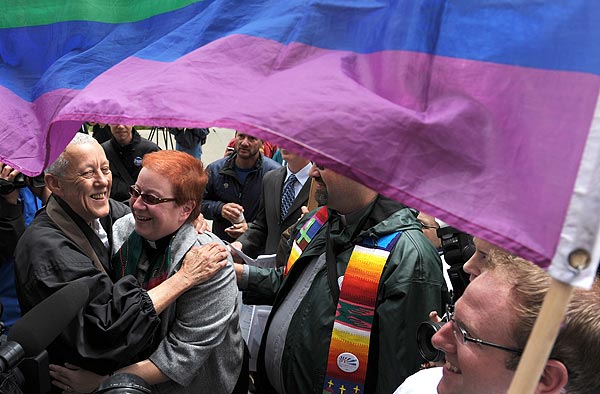
Ruling Against Prop. 8 Could Lead to Federal Precedent on Gay Marriage


Judge says the same-sex marriage ban was rooted in 'moral disapproval' and violates constitutional rights to equal protection and due process. Opponents vow to appeal all the way to the Supreme Court.
 
By Maura Dolan and Carol J. Williams, Los Angeles Times
08.04.10

A federal judge declared California's ban on same-sex marriage unconstitutional Wednesday, saying that no legitimate state interest justified treating gay and lesbian couples differently from others and that "moral disapproval" was not enough to save the voter-passed Proposition 8.

California "has no interest in differentiating between same-sex and opposite-sex unions," U.S. District Chief Judge Vaughn R. Walker said in his 136-page ruling.

The ruling was the first in the country to strike down a marriage ban on federal constitutional grounds. Previous cases have cited state constitutions.

Lawyers on both sides expect the ruling to be appealed and ultimately reach the U.S. Supreme Court during the next few years.

It is unclear whether California will conduct any same-sex weddings during that time. Walker stayed his ruling at least until Friday, when he will hold another hearing.

In striking down Proposition 8, Walker said the ban violated the federal constitutional guarantees of equal protection and of due process.

Previous court decisions have established that the ability to marry is a fundamental right that cannot be denied to people without a compelling rationale, Walker said. Proposition 8 violated that right and discriminated on the basis of both sex and sexual orientation in violation of the equal protection clause, he ruled.

The jurist, a Republican appointee who is gay, cited extensive evidence from the trial to support his finding that there was not a rational basis for excluding gays and lesbians from marriage. In particular, he rejected the argument advanced by supporters of Proposition 8 that children of opposite-sex couples fare better than children of same-sex couples, saying that expert testimony in the trial provided no support for that argument.

"The evidence shows conclusively that moral and religious views form the only basis for a belief that same-sex couples are different from opposite-sex couples," Walker wrote.

Andy Pugno, a lawyer for the backers of the ballot measure, said he believed Walker would be overturned on appeal.

Walker's "invalidation of the votes of over 7 million Californians violates binding legal precedent and short-circuits the democratic process," Pugno said.

He called it "disturbing that the trial court, in order to strike down Prop. 8, has literally accused the majority of California voters of having ill and discriminatory intent when casting their votes for Prop. 8."

At least some legal experts said his lengthy recitation of the testimony could bolster his ruling during the appeals to come. Higher courts generally defer to trial judges' rulings on factual questions that stem from a trial, although they still could determine that he was wrong on the law.

John Eastman, a conservative scholar who supported Proposition 8, said Walker's analysis and detailed references to trial evidence were likely to persuade U.S. Supreme Court Justice Anthony M. Kennedy, a swing vote on the high court, to rule in favor of same-sex marriage.

"I think Justice Kennedy is going to side with Judge Walker," said the former dean of Chapman University law school.

Barry McDonald, a constitutional law professor at Pepperdine University, said Walker's findings that homosexuality is a biological status instead of a voluntary choice, that children don't suffer harm when raised by same-sex couples and that Proposition 8 was based primarily on irrational fear of homosexuality "are going to make it more difficult for appellate courts to overturn this court's ruling."

Edward E. (Ned) Dolejsi, executive director of the California Catholic Conference, said he believed the judge's ruling was both legally and morally wrong.

"All public law and public policy is developed from some moral perspective, the morality that society judges is important," he said. To say that society shouldn't base its laws on moral views is "hard to even comprehend," he said.

In his decision, Walker said the evidence showed that "domestic partnerships exist solely to differentiate same-sex unions from marriage" and that marriage is "culturally superior."

He called the exclusion of same-couples from marriage "an artifact of a time when the genders were seen as having distinct roles in society and marriage."

"That time has passed," he wrote.

Although sexual orientation deserves the constitutional protection given to race and gender, Proposition 8 would be unconstitutional even if gays and lesbians were afforded a lesser status, Walker said. His ruling stressed that there was no rational justification for banning gays from marriage.

To win a permanent stay pending appeal, Proposition 8 proponents must show that they are likely to prevail in the long run and that there would be irreparable harm if the ban is not enforced.

Lawyers for the two couples who challenged Proposition 8 said they were confident that higher courts would uphold Walker's ruling.

"We will fight hard so that the constitutional rights vindicated by the 138-page, very careful, thoughtful, analytical opinion by this judge will be brought into fruition as soon as possible," pledged Ted Olson, one of the lawyers in the case.

Other gay rights lawyers predicted that the ruling would change the tenor of the legal debate in the courts.

"This is a tour de force — a grand slam on every count," said Shannon Price Minter, legal director for the National Center for Lesbian Rights. "This is without a doubt a game-changing ruling."

Wednesday's ruling stemmed from a lawsuit filed last year by two homosexual couples who argued that the marriage ban violates their federal constitutional rights to equal protection and due process.

The suit was the brainchild of a gay political strategist in Los Angeles who formed a nonprofit to finance the litigation.

The group hired two legal luminaries from opposite sides of the political spectrum to try to overturn the ballot measure. Former U.S. Solicitor General Theodore B. Olson, a conservative icon, signed on with litigator David Boies, a liberal who squared off against Olson in Bush vs. Gore, the U.S. Supreme Court ruling that gave George W. Bush the presidency in 2000.

Gay-rights groups had opposed the lawsuit, fearful that the U.S. Supreme Court might rule against marriage rights and create a precedent that could take decades to overturn.

But after the suit was filed, gay rights lawyers flocked to support it, filing friend-of-court arguments on why Proposition 8 should be overturned.

Gov. Arnold Schwarzenegger and Atty. Gen. Jerry Brown refused to defend the marriage ban, leaving the sponsors of the initiative to fill the vacuum. They hired a team of lawyers experienced in U.S. Supreme Court litigation.

Proposition 8 passed with a 52.3% vote six months after the California Supreme Court ruled that same-sex marriage was permitted under the state Constitution.

At trial, the opponents of Prop. 8 presented witnesses who cited studies that showed children reared from birth by gay and lesbian couples do as well as children born into opposite-sex families. They also testified that the clamor for marriage in the gay community had given the institution of marriage greater esteem.

The trial appeared to be a lopsided show for the challengers, who called 16 witnesses, including researchers from the nation's top universities, and presented tearful testimony from gays and lesbians about why marriage mattered to them.

The backers of Proposition 8 called only two witnesses, and both made concessions under cross-examination that helped the other side.

The sponsors complained that Walker's pretrial rulings had been unfair and that some of their prospective witnesses decided not to testify out of fear for their safety.

When Walker ruled that he would broadcast portions of the trial on the Internet, Proposition 8 proponents fought him all the way to the U.S. Supreme Court and won a 5-4 ruling barring cameras in the courtroom.

The trial nevertheless was widely covered, with some groups doing minute-by-minute blogging. Law professors brought their students to watch the top-notch legal theater.

An estimated 18,000 same-sex couples married in California during the months it was legal, and the state continues to recognize those marriages.

Experiencing California: The Egg & Sperm Ride


Minnesota artist Janeki Ranpura has organized the Egg & Sperm Ride. An Egg will be pedaled on a solo ride from Minneapolis to meet up with Sperm Riders, here in San Jose, for a parade. Ranpura is looking for riders in Silicon Valley willing to wear a glowing sperm helmet and ride in a parade during the 2010 biennial 01SJ festival.

If you are interested, and you will be in San Jose on Sept. 18th and 19th, email janaki@eggandspermride.org.

Tuesday, August 3, 2010

Annotated Bibliography Assignment


For this assignment, you will create an annotated bibliography that supports your research paper. in addition to citing your source, you will briefly:

1. Summarize the cited source (2-3 sentences)
2. Explain how you intend to use the source in your paper (2-3 sentences)

Be sure to strictly follow MLA works cited formatting style (MLA examples can be found here). Find a sample annotated bibliography here.

Example:

Hibbs, Jay. Skinny at Any Cost: America Obsessed. New York City: Lowell Books, 2006.

Skinny at Any Cost is an analysis of the American dieting industry's stranglehold on consumers. It examines the techniques the industry uses to convince American women, and increasingly men, that perfection awaits them through a variety of dieting procedures and plans. I intend on using the book to support my thesis that the dieting industry actually impedes Americans from maintaining healthy lifestyles. Specifically, I will cite from the chapter on health care to illustrate the ways in which the industry endorses unhealthy practices.

Requirements:
  • MLA format
  • Minimum of 6 outside sources (do not count Wikipedia as a source), listed in a works cited page
Due: Wednesday, August 4th

He Lit Oakland's Fire for Pot Factories

Retired builder Jeff Wilcox's vision of a 'business park of cannabis' stoked the council's appetite for the jobs, and tax revenue, such a thing could generate for the desperate city.

By John Hoeffel, Los Angeles Times
08.02.10

Jeff Wilcox lopes across the nearly empty parking lot, aiming for a large brick building. Inside, he excitedly shows off the cavernous space, once used to make wire, vacant now for a decade. He imagines it running 24/7, filled with glowing lights, gurgling irrigation systems, whirling ventilators and workers coaxing thousands of pungent marijuana plants to bud.

And that's just one part of his proposal. Wilcox, a retired builder, owns a campus of aging, idled industrial plants. On a wall in an unused conference room, a sketch of the property shows how he could fill most of the 172,000 square feet with growers raising high-end pot and entrepreneurs turning out brownies, drinks, tinctures and other products.

"My idea was a business park of cannabis," he said.

He sold the idea to Oakland's City Council. Desperate for new jobs and tax revenue, the council gave its final approval last month to allow four enormous marijuana factory farms. Wilcox and more than 220 others have expressed interest in applying for the permits to be awarded next year.

The city's audacious plan has inspired talk that Oakland could become the Silicon Valley of pot, home to the world's first state-of-the-art marijuana start-ups.

Comparing the economic potential of tetrahydrocannabinol to silicon chips may seem far-fetched. Some observers dismiss the notion as the fever dream of budget-traumatized politicians. But others think Oakland could be uniquely positioned to capitalize on the business opportunities created by the growing tolerance toward marijuana.

Rebecca Kaplan, the City Council member who pushed the plan, has a simple retort when asked whether the vision of Oakland at the center of a marijuana economy is fanciful: Montel Williams. The television talk-show host and motivational coach has multiple sclerosis, smokes marijuana to relieve nerve pain and has visited Kaplan, as she put it, "live in City Hall."

"He has wanted for years to open up a facility where he could produce really high-end medical cannabis extracts," she said, explaining that Williams heard through the grapevine that Oakland was the place to do it. "I would love to have Montel Williams here running a business." Williams could not be reached for comment.

Kaplan said she believed that Oakland has two essential ingredients other California cities do not: political will and industrial space. "Oakland has been a major hub of the medical cannabis movement, so that's part of what I mean when I say political will," she said.

No other city has provided such red-carpet treatment. Oakland is essentially trying to set up legal sanctuaries for pot businesses, although the move may prove too brazen for federal narcotics agents who recently called city officials to request a copy of the ordinance.

Only Berkeley, its liberal neighbor, has considered anything similar. The city will ask voters to approve six marijuana operations no larger than 30,000 square feet. But Oakland has 10 times the available industrial space, about 2.3 million square feet, and it rents for half the price.

Berkeley Mayor Tom Bates said Oakland's stock of empty industrial buildings could make it a "major player."

"Oakland is trying to become the growing mecca of the north," he said.

Jeff Jones, who founded Oakland's first cannabis club, noted that the bayside city has another advantage. "Oakland is not Holland, it's not Amsterdam; it's more like Rotterdam. It's going to be a hub for transport," he predicted. "I can imagine walking into Holland's coffee shops and finding a strain of cannabis marketed as made in California."

There are skeptics. "I think it's a big stretch," said Larry Tramutola, a political consultant who lives in Oakland. He said marijuana could have a long-term economic effect on the city but thought it would be minor. "I don't think it's going to solve all the budgetary issues," he said.

Even Dale Gieringer, an Oakland resident who as the head of California NORML advocates for marijuana legalization, has doubts. He noted that state law blunts the get-rich-overnight incentive that powers Silicon Valley. Only nonprofit collectives are allowed to grow pot.

But Oakland, like Silicon Valley, has been fertile ground for entrepreneurs and innovative thinkers, luring them from all over. Jones is from South Dakota. Richard Lee, who started the first trade school to train marijuana businessmen, moved from Texas. Steve DeAngelo, who came from Washington, D.C., runs Harborside Health Center, a $20-million-a-year dispensary that has become the largest and arguably the most professionally run marijuana retailer in the world.

"As we get closer and closer to legal cannabis, more and more new players are going to want to get into cannabis," DeAngelo said. "I think it's a sign that this industry is emerging out of the shadows and into the light, and we are gaining acceptance among mainstream figures."

Wilcox is one of those mainstream figures. He says he started smoking pot when he was 15 and now uses it medicinally for back pain, but the 50-year-old single father with three teenagers is strait-laced. He sold his construction firm five years ago and retired. But he was bored. He didn't see marijuana as a business opportunity until DeAngelo approached him about growing in his buildings, which are next to Harborside.

"I don't look like a pothead, obviously," he said, "and I struggled with the moral issues for a while, security issues, everything else; and then I decided I wanted to do something with my life."

Now he is Oakland's equivalent of a Sand Hill Road venture capitalist and a tilt-up office developer rolled into one. He has money, connections and 7.4 acres off Interstate 880.

Wilcox, who knows his way around City Hall after two decades as a major contractor, approached the idea shrewdly. He set up a company called AgraMed and spent $16,000 to study its economic potential. The 68-page report concluded that he could sell marijuana worth $59 million a year. With a 5% pot tax that the City Council decided last week to put on the November ballot, Wilcox's operation could pay Oakland $3.4 million a year in taxes. "We did this to move the legislation," he said.

He also sought help from Dan Rush, a local labor leader with City Hall clout, and promised to hire hundreds of union workers. He reached out to Lee, who is well-regarded at City Hall. He donated $20,000 to the legalization initiative that Lee is backing in November. He hired a lobbyist. He made a few modest political donations.

And he made it known that he was willing to spend $20 million to convert his buildings into an incubator for marijuana businesses. "It's just such a mind-boggling thing. It makes you speechless," said Arturo Sanchez, who oversees the city's medical marijuana programs.

Wilcox won over City Council members despite intense opposition from some marijuana activists and growers who supply the Oakland market. Wilcox, who cheerfully acknowledges he enjoys a good brawl, boasts that he won the turf war.

"There was a transfer of power," he said. "In essence, you could say big business is here."

Sunday, August 1, 2010

Week Nine: Santa Cruz


Cowell's Beach

Oh, you gotta be, oh, you gotta be
still living by the sea.

Oh, you gotta be, oh, you gotta be.

'Cause Santa Cruz
you're not that far.
Oh, Santa Cruz,
no, you're not that far.

—The Thrills, "Santa Cruz (You're Not That Far)"

Week 9
M 8.2
READ
MC: “Transients in Paradise” by Aimee Lu, “The Last Little Beach Town” by Edward Humes, “Bienvenidos a Newport Beach” by Firoozeh Dumas, “Berkeley” by Michael Chabon, “The Line” by Ruben Martinez, “Flirting with Urbanismo” by Patt Morrison, “My Little Saigon” by Ahn Do, “The Nicest Person in San Francisco” by Derek Powaze, “The Un-California” by Daniel Weintraub; MANY: “Los Angles Notebook” by Joan Didion, “Wildflowers” by David Mas Masumoto; eR: “What is San Francisco?” by Herb Caen, “Pink Elephant Hunting” by Gary Singh

IN-CLASS
Reading discussion; Presentations; Preview—Personal essay

DUE
Annotated bibliography
(Note: Since I've had computer issues the past week, I'll take this on Wednesday, as well.)

W 8.4
IN-CLASS
Personal essay; Writers workshop

DUE
Research paper, pages 1-4 (Bring 3 copies)

UPCOMING:

Week 10
M 8.9
IN-CLASS
Writers workshop; Final exam prep

DUE  
Research paper, pages 1-8 (Bring 3 copies)

W 8.11
IN-CLASS
Final Exam; Course review

DUE
Research paper

Saturday, July 31, 2010

The Tortilla Takes a Road Trip to Korea


By John T. Edge, New York Times
07.27.10

TOMAS LEE has long dreamed of selling American consumers on Korean barbecue.

Mr. Lee, a 42-year-old native of Seoul, South Korea, who grew up in Mustang, Okla., took a step toward realizing that dream in October 2009 when he opened Hankook Taqueria in Atlanta, serving tacos stuffed with soy- and garlic-marinated beef, along with chicken and pork, all barbecued in the Korean style.

“I was going to open a traditional Korean barbecue restaurant,” Mr. Lee said. Then his wife, Mackenzie, had an idea. “She saw this thing about Kogi on the Web,” he recalled. “And I thought tacos might be a way to get Korean food on everybody’s table.”

What captured Ms. Lee’s attention was Kogi Korean BBQ-To-Go, a retrofitted catering truck that rolled onto the streets of Southern California in November 2008, selling corn tortillas piled with Korean-style barbecued short ribs known as kalbi, garnished with onion, cilantro and a hash of chili-soy-dressed lettuce.

Eighteen months later, dozens of entrepreneurs across the country are selling Korean tacos. Like Buffalo wings and California rolls, Korean tacos have gone national, this time with unprecedented speed. Few of these entrepreneurs appear to have made pilgrimages to Southern California to eat at a Kogi truck. (There are now five.) Many, especially those of Korean ancestry, say they studied news media reports of the Kogi concept, recognized their culture at the core, and made the concept their own.

“You get the feeling that this is our chance to mainstream Korean food,” said Jae Kim, a Seoul native, selling Korean tacos since February at his Chi’Lantro truck in Austin, Tex. “And it’s happening so quickly. It’s like everybody is realizing that it’s now or never.”

“I’ve never tasted anything like this before,” said Tim Burroughs, a recent customer at Hankook Taqueria. “It’s as if they’re making up a cuisine as they go.”

Granted, Koreans have long eaten kalbi wrapped in lettuce leaves, in a taco-like fashion. But it’s a 21st-century paradox that Korean food, still considered exotic by many Americans, has begun to gain widespread acceptance, when wrapped in a Mexican flatbread and topped with taco truck embellishments.
Last month in Indianapolis, John Ban, 31, raised in Indiana by Korean parents, and Arnold Park, 28, a native of Seoul, began selling $2 tacos — corn tortillas piled with nubs of beef, chopped onions, cilantro leaves and red jalapeño salsa — late at night to club kids who visited their West Coast Tacos truck.

“First we were going to move to Korea and open a regular taco truck,” said Mr. Ban, who has worked as a D.J. and hip-hop artist. “Then we thought we’d do a Korean taco truck in Korea. We settled on doing a Korean taco truck in Indianapolis.”

“The meat makes it Korean,” said Mr. Ban, who marinates chuck roll in a soy and garlic sauce that is traditionally used with Korean barbecue dishes.

“The tortilla and the toppings are a way to tell our customers that this food is O.K., that this food is American.”

Cecilia Hae-Jin Lee, a native of Seoul, raised in Southern California by parents who ran a bodega that catered to a Mexican clientele, said the Mexican-Korean culinary connection was born of proximity.

“The idea of Korean tacos isn’t new,” said Ms. Lee, who wrote a guidebook to South Korea and recently finished writing a Mexican cookbook. “Koreans run stores. They hire Mexican workers. They eat together.”

“Before, when Koreans ran out of rice and grabbed a tortilla to go with our kalbi, we called it lunch,” she added. “Now we call it a Korean taco.”

The dish may have honest folk roots, but many Korean taco makers across the country recognize Roy Choi, a Kogi founder, as the pioneering force.

“Chef Roy was the alpha,” said Bo Kwon, who has been serving Korean Oregon Infusion BBQ from his Koi Fusion trucks in Portland, Ore., since May 2009.

“We just Portlandize what he did in L.A.,” said Mr. Kwon, whose menu borrowed from Mr. Choi’s in the manner that 50 Cent sampled Biggie Smalls.

Mr. Choi respects the work of Koi Fusion, where the specialty is a marinated short-rib taco, a virtual Kogi knockoff dressed with shredded cabbage, chopped onions, scallions, bean sprouts, cilantro, daikon sprouts and salsa.

But he worries about what will happen as more and more restaurateurs adopt the form.

“If Kogi-inspired trucks change how American eats, I’ll be a pig in slop,” Mr. Choi told a November 2009 gathering of chefs at the Culinary Institute of America’s Greystone campus in St. Helena, Calif. “But if their food isn’t any good, I’ll be Kurt Cobain.”

Mr. Choi’s day of reckoning may come soon, for Kogi-inspired tacos are now legion.

Four Portland vendors compete with Koi Fusion, including Boolkogi, Bulkogi and Korean Twist.

Ten or more trucks now roll through Southern California, where Bool Korean BBQ Tacos & Pastels serves Korean, Mexican and Brazilian foods. Calbi Fusion Tacos and Burritos, financed by an investor in the Baja Fresh Mexican Grill chain, is selling franchises.

In the Bay Area, home to a half-dozen or so operators, Jomar Guevarra, a Filipino, and Sam Pak, born in California to Korean parents, work the MoGo truck, dishing short-rib tacos as well as bacon-wrapped and kimchi-topped hot dogs.

Although Korean taco saturation is greatest in California, the growth of the genre is not restricted to the West Coast.

At Meritage in Philadelphia, Anne Coll, former chef of the Chinese-French restaurant Susanna Foo, serves a Wednesday night special of braised short-rib tacos, topped with kimchi. (The sous chef Ann Suk Miller, whose mother is Korean, previously served a very similar dish at Ansill, another restaurant in the city.)

In Austin, Mr. Kim, the owner of Chi’Lantro, dishes tofu tacos with a soy vinaigrette salad. “Korean tacos are what’s next,” he said. “After that, maybe it’s Korean pizza.”

In Chicago, Steve Lee, born in the countryside outside Seoul, serves chips and salsa, aguas frescas and kimchi-topped tacos at Taco Chino, a restaurant he opened in December in a strip mall.

“A lot of Mexican restaurants have just one flavor,” Mr. Lee said. “I wanted to add another flavor.”

Also in town, Del Seoul, featuring Korean-inspired dishes like kalbi tacos stuffed with short ribs and the rice dish bibimbap threaded with turnip greens, plans to open late this summer.

Trend-conscious restaurateurs, some with few apparent ties to Korea, have also adopted Korean tacos as their own.

In Brooklyn, the Oaxaca restaurants advertise “traditional Mexican fare,” but serve specials of kalbi tacos topped with Asian pear slaw. Sagaponack, a seafood restaurant and raw bar in the Flatiron district of Manhattan named for a Long Island village, serves kalbi tacos and pesto fries.

Meanwhile, in January, Ducks Eatery, set within SPiN, a table tennis parlor in the Flatiron district, began serving short-rib tacos with oyster kimchi and miso aioli.

While the trend, which Mr. Kwon of Koi Fusion has called “the movement,” shows no signs of abating, a few Korean taco businesses have already come and gone.

Yummo, a frozen yogurt cafe in Kansas City, Mo., that sold short-rib tacos with homemade kimchi, closed last fall. Kogi Shop, a Korean taco truck in Oklahoma City that was started in November 2009 by a Korean husband-and-wife team from Los Angeles, last updated its Twitter feed in March.

And variations on the Korean taco form were inevitable.

Julia Sharaby, of German and Cherokee descent, runs Fusion Taco, a truck serving short-rib quesadillas and chicken satay tacos in Houston. In Los Angeles, Masamichi Kiyomiya, proprietor of LA Chicken, serves Japanese chicken tacos.

In August 2009, Tan Truong and Jonathan Ward rolled out Kung Fu Tacos, a bright yellow truck, selling nun chuk chicken and wu shu char siu to office workers in San Francisco’s financial district.

The partners had planned a trip to Los Angeles to sample Kogi’s food. But then it hit them. “My wife is Chinese,” Mr. Ward recalled. “Why would I try Korean tacos when I could try Chinese tacos? So I texted Tan. I wrote ‘char siu taco.’ And he wrote back ‘brilliant.’ ”

Recalibration has already begun.

Namu is a sleek restaurant in San Francisco operated by the brothers Dennis, Daniel and David Lee. They call their cookery “cutting edge, new California.” Born in the United States to Korean parents, the Lees serve dishes like asparagus with guanciale, maitake mushrooms and a tofu-sesame purée.

Now on the dinner menu are “real Korean tacos,” of kalbi and sesame rice, topped with kimchi remoulade and daikon salsa, folded into toasted seaweed pouches.

“Every time someone from the press called, they asked if we made Korean tacos,” David Lee said. “It was like we were being typecast. They were thinking, ‘Hey, you’re Korean, you must make Korean tacos.’ ”

“So we gave them they wanted,” Mr. Lee said. “Korean tacos, but on our own terms.”

Monday, July 26, 2010

Haunted Hotel Spooks "Ghost Adventures" Stars

By David Moye, AOLNews.com
07.27.10

If there was any way to monitor TV ratings in the afterlife, the Travel Channel series "Ghost Adventures" would probably make a killing.

The show, which starts its fourth season in September, is not only one of the cable network's most popular, but series stars Zak Bagans, Nick Groff and Aaron Goodwin are becoming as well known in the netherworld as they are in the real one.

"A lot of people think that this, because it's on television, is entertainment, and we're out there yelling and screaming for no reason," Bagans told AOL News. "We live with things that follow us constantly. This 'door' has been open so long that it just constantly keeps getting wider and wider. So when we go places, it's almost like we're known in the spirit world.

"We go places that we haven't even been yet, and they call our names. They say, 'Zak! Nick, come in!' all the time."

Bagans, Groff and Goodwin, on a promotional tour for their series, were in San Diego recently to meet their living fans at Comic-Con, but graciously gave any ghostly groupies a chance to say hello as well by agreeing to be interviewed in Room 3327 at the Hotel Del Coronado, a world-famous hotel with a world-famous ghost by the name of Kate Morgan.

Morgan has been scaring up business since 1892 when she reportedly took her own life after spending five lonely and lovesick days at the hotel waiting for a man who never arrived.

Although the hotel has hosted such living luminaries as Bill Clinton, "Weird" Al Yankovic and the cast of "Baywatch," Morgan is the most famous permanent resident. Her hotel room is popular with guests, many of whom report having strange paranormal experiences while staying there.

In other words, the perfect place for an interview with ghost experts like these guys, right?

In fact, Bagans says he, Groff and Goodwin prefer to stay in haunted hotels whenever possible.

"It's what we live in," he says. "This is our environment, so to be around it, personally, makes me more comfortable."

Groff agrees.

"We've been doing this for so long that usually when we walk in, we can pick up stuff right away," he says.


At that moment, a water bottle suddenly flies out of the hand of the show's publicist, Diane McNamara, and lands seven feet away at my feet. The suddenness freaks out McNamara, causing her to leave the room and stay away for the remainder of the interview.

"I felt immense sadness in that room," she says teary-eyed after the interview. In another interview, a day later, she adds, "It's actually been that way since we checked in. I keep asking to have my room changed."

Groff, on the other hand, is used to encounters like this.

"That's the kind of weird stuff that happens just like that," he says.

McNamara is quick to add that she has never had any paranormal encounters before. Bagans and Groff are just as quick to add that they've never seen her as agitated as when her water bottle flew out of her hand.

Considering what has just happened, it seems an investigation is in order. Groff takes out a digital recorder to record any possible sound impressions. Sometimes a recording in a silent room can reveal strange messages, presumably from spirits.

The trio requests a moment of silence for the mini-investigation. Before turning on the recorder, Groff warns all those in the room that if they have to say something, they should not whisper, lest it be confused as a message from the afterlife.

"OK, we're in Kate Morgan's room; Zak, Nick, Aaron, David, Carrie Ann [the Hotel Del Coronado's publicist]," Groff says.

Bagans, who works as the lead investigator, steps in to make contact with whatever entity might be in the room.

"This is Zak," he says. "Can I ask you a question? I just saw one of our friends act in a way that we've never seen before, and I clearly saw a bottle taken out of her hand without any movement on her part whatsoever and fly about seven feet. I want to ask you, Are you angry with us? Or were you just trying to get our attention? 'Cause you really, really frightened her, and I know you weren't trying to do that. But can you give us a sign now? Can you shut this door for me? Can you just do that? Or would you rather appear in this mirror? Might be easier."

Groff adds his two cents.

"Kate? Are you here with us? If you are, can you throw something or move something so we know you're there?"

Bagans then asks the mysterious spook why it pushed the bottle out of McNamara's hand and says offhand to Groff, "It f---ing flew!"

Groff agrees, saying, "Yeah, it flew" before turning back to the ghost. "Kate, can you tell us right here why you threw that?"

Bagans: "I'm starting to feel something."

Groff continues the line of questioning. "Were you mad that she was in here?"

At this moment, Bagans mentions the sound of leaves rustling outside the window and explains that the crew always notes these noises when doing a digitally recorded investigation so they don't overreact to the noises during playback.

Then he returns his attention back to whatever entity may have made the water bottle fly across the room.

"Kate, is that you or somebody else?" he asks. "Did you follow us here? Are you a male?"

He pauses for a moment and visually scours the room. Then he focuses his attention on the backpack on the bed.

"My red tag just moved," he says quickly to the others. "Were you watching that?"

Groff uses this as an opening.

"Do you not like that backpack on the bed?" he asks.

Bagans follows up the questioning.

"Is it because it's mine? Are you trying to get my sacred chrism out of there?" he asks, later explaining that the chrism is a special anointing oil he uses to protect himself from the occasional evil entity. In passing, he mentions that he has a really good exorcist on speed dial.

Throughout this, Goodwin, who is often set up as "ghostly bait" by Groff and Bagans, continues to visually scour the room, mostly checking for cracks, drafts and any signs for strange energy, such as sudden cold or hot spots in a room.

He and Groff then lead Bagans over to a spot near the closet that fits the bill.

"It feels cool on my arm," Goodwin says.

Despite this feeling, and a general tingly feeling, no more experiences occur. Bagans says this is common.

"A lot of times, just like that, they can just be here for a fraction of a second, and then they're just gone," he says. "It's as if they've left through some kind of doorway. It always seems like our world and their world are like two pieces of Swiss cheese that are constantly moving, and occasionally the holes match up for just a second."

Bagans has been documenting his ghost hunting since 2004. He, Groff and Goodwin have come to believe that what we consider to be ghosts fall into three types:

  • Residual energy of people who had shocking experiences, such as being murdered
  • Intelligent beings capable of answering questions from humans
  • Demonic beings that mimic the sounds of children.
Groff's experiences have convinced him that evil people give off a very powerful energy.

"You have good people in this world, and you have bad people," he says. "We go to a lot of pretty vicious prisons. At the end of the day, you realize these are some pretty vicious people -- rapists and murderers -- and you wonder what happens to their energy when they die.

"Well, that energy still lingers. And when we go to these jails where they don't want you there, they can harm you or
do something to you or make you feel like your equilibrium is thrown off."

Another discovery that Groff has made in the three seasons that "Ghost Adventures" has been on the air is that evil is very hot.

"We just captured an amazing piece of evidence on a thermal cam," he says. "We felt a piece of really really warm heat right before we captured something on our thermal camera, and we're learning that the warm presences are actual evil entities, bad spirits. So I think bad spirits give off more of a warm energy."

So how do the guys keep the bad energy away from them?

Well, they each have different ways, but Bagans swears by his sacred chrism, an olive oil version of holy water that he uses to anoint his body at key moments.

"I don't leave home without it," he says.

It's a good thing too. During one encounter in the coming season, Bagans says he was surrounded by such evil that the oil itself created a burning sensation on his forehead, unlike any other he has experienced.

It might get tough at times, but Bagans believes he is following a path of destiny. His paranormal passion was stoked by a face-to-face encounter with the spirit of a suicidal woman who haunted his old apartment building in Trenton, Mich.

"My life was very bad at one point until I had this huge experience with this ghost, and it changed my life for the better," he says.

At that moment, the impromptu investigation is deemed over, but Bagans, Groff and Goodwin agree that they need to come back to the hotel to investigate further. Bagans also admits that while he's sympathetic toward McNamara's skittish reaction at the encounter, he has a different reaction.

"To know somebody who's not trying to put herself in this position, to see how uncomfortable she was walking down the hallway, to see a bottle fly from her hand seven feet. It's frightening to her, but it puts a smile on my face," he says.

Editorial Assignment


What do you consider to be California's most pressing issue? Jobs? Real estate costs? Partisan politics? Transportation? Immigration? Public employee pensions? Crumbling infrastructure? Education funding? Prisons? In an editorial, illustrate 1) what you consider to be the state's most significant problem and 2) your argument as to why this should be one of the state's top priorities. You do not have to provide a solution for the problem per se, but you must stress the urgency of the issue you choose. In other words, why should California focus its resources on this problem? What will be the consequences of ignoring the issue? Cite evidence from the articles we read this week to support your thesis.


Requirements:
  • MLA format, including parenthetical citation
  • 2.5-page minimum
  • Cite at least three articles

    The best papers:
    • Stay within the parameters of the subject matter
    • Have a concise thesis which clearly outlines a position
    • Clearly support the thesis with solid evidence and a logical structure, citing at least three articles from the reader
    • Cite a minimum of three articles to support the thesis
    • Conclude with a summation of the argument
    • Properly cite evidence using MLA's parenthetical citation method
    • Are in compliance with MLA Style

      Sample editorials:

        Due: Wednesday, July 28th

        Sunday, July 25, 2010

        Week Eight: Lodi


        The Lodi Mission Arch


        Just about a year ago,
        I set out on the road,
        seeking my fame and fortune.
        Looking for a pot of gold.
        Things got bad, and things got worse,
        I guess you will know the tune.
        Oh Lord, stuck in Lodi again.

        —Creedence Clearwater Revival, "Lodi"

        Week 8
        M 7.26
        READ
        eR: “California: Ruined by the Supermajority” by Joe Matthews, “What’s the Matter with California?” by Robery Mackey and Liz Robbins, “Silicon Valley Loses Best-Workplace Luster After Job, Pay Cuts” by Ryan Flinn, “Fortune 500’s Flee California” by Michelle Steel, "California' Rebound Forecast to Lag Behind Nation's" by Alana Semuels

        IN-CLASS
        Reading discussion, Presentations; Preview—Editorial essay

        DUE
        Persuasive essay (Attach first and second drafts)

        W 7.28
        READ
        eR: “The California Quagmire” by Karl Manheim, John S. Caragozian, and Don Warner, “Is Marijuana the Answer to California’s Budget Woes?” by Tom McNichol, "Cracks in the Future" by Bob Herbert, 'Why California is Still America's Future" by Michael Grunwald, “Californians Pessimistic about Future” from AirTalk, KPCV (audio program)

        IN-CLASS
        Writers workshop, Presentations

        DUE
        Editorial essay
        ; Research paper (Bring 3 copies of the first 2 pages of your paper)

        UPCOMING:

        Week 9

        M 8.2
        READ
        MC: “Transients in Paradise” by Aimee Lu, “The Last Little Beach Town” by Edward Humes, “Bienvenidos a Newport Beach” by Firoozeh Dumas, “Berkeley” by Michael Chabon, “The Line” by Ruben Martinez, “Flirting with Urbanismo” by Patt Morrison, “My Little Saigon” by Ahn Do, “The Nicest Person in San Francisco” by Derek Powaze, “The Un-California” by Daniel Weintraub; MANY: “Los Angles Notebook” by Joan Didion, “Wildflowers” by David Mas Masumoto; eR: “What is San Francisco?” by Herb Caen, “Pink Elephant Hunting” by Gary Singh

        IN-CLASS
        Reading discussion; Presentations; Preview—Personal essay

        DUE
        Annotated bibliography


        W 8.4
        IN-CLASS
        Personal essay; Writers workshop

        DUE
        Research paper, pages 1-4 (Bring 3 copies)