Saturday, July 31, 2010

The Tortilla Takes a Road Trip to Korea


By John T. Edge, New York Times
07.27.10

TOMAS LEE has long dreamed of selling American consumers on Korean barbecue.

Mr. Lee, a 42-year-old native of Seoul, South Korea, who grew up in Mustang, Okla., took a step toward realizing that dream in October 2009 when he opened Hankook Taqueria in Atlanta, serving tacos stuffed with soy- and garlic-marinated beef, along with chicken and pork, all barbecued in the Korean style.

“I was going to open a traditional Korean barbecue restaurant,” Mr. Lee said. Then his wife, Mackenzie, had an idea. “She saw this thing about Kogi on the Web,” he recalled. “And I thought tacos might be a way to get Korean food on everybody’s table.”

What captured Ms. Lee’s attention was Kogi Korean BBQ-To-Go, a retrofitted catering truck that rolled onto the streets of Southern California in November 2008, selling corn tortillas piled with Korean-style barbecued short ribs known as kalbi, garnished with onion, cilantro and a hash of chili-soy-dressed lettuce.

Eighteen months later, dozens of entrepreneurs across the country are selling Korean tacos. Like Buffalo wings and California rolls, Korean tacos have gone national, this time with unprecedented speed. Few of these entrepreneurs appear to have made pilgrimages to Southern California to eat at a Kogi truck. (There are now five.) Many, especially those of Korean ancestry, say they studied news media reports of the Kogi concept, recognized their culture at the core, and made the concept their own.

“You get the feeling that this is our chance to mainstream Korean food,” said Jae Kim, a Seoul native, selling Korean tacos since February at his Chi’Lantro truck in Austin, Tex. “And it’s happening so quickly. It’s like everybody is realizing that it’s now or never.”

“I’ve never tasted anything like this before,” said Tim Burroughs, a recent customer at Hankook Taqueria. “It’s as if they’re making up a cuisine as they go.”

Granted, Koreans have long eaten kalbi wrapped in lettuce leaves, in a taco-like fashion. But it’s a 21st-century paradox that Korean food, still considered exotic by many Americans, has begun to gain widespread acceptance, when wrapped in a Mexican flatbread and topped with taco truck embellishments.
Last month in Indianapolis, John Ban, 31, raised in Indiana by Korean parents, and Arnold Park, 28, a native of Seoul, began selling $2 tacos — corn tortillas piled with nubs of beef, chopped onions, cilantro leaves and red jalapeño salsa — late at night to club kids who visited their West Coast Tacos truck.

“First we were going to move to Korea and open a regular taco truck,” said Mr. Ban, who has worked as a D.J. and hip-hop artist. “Then we thought we’d do a Korean taco truck in Korea. We settled on doing a Korean taco truck in Indianapolis.”

“The meat makes it Korean,” said Mr. Ban, who marinates chuck roll in a soy and garlic sauce that is traditionally used with Korean barbecue dishes.

“The tortilla and the toppings are a way to tell our customers that this food is O.K., that this food is American.”

Cecilia Hae-Jin Lee, a native of Seoul, raised in Southern California by parents who ran a bodega that catered to a Mexican clientele, said the Mexican-Korean culinary connection was born of proximity.

“The idea of Korean tacos isn’t new,” said Ms. Lee, who wrote a guidebook to South Korea and recently finished writing a Mexican cookbook. “Koreans run stores. They hire Mexican workers. They eat together.”

“Before, when Koreans ran out of rice and grabbed a tortilla to go with our kalbi, we called it lunch,” she added. “Now we call it a Korean taco.”

The dish may have honest folk roots, but many Korean taco makers across the country recognize Roy Choi, a Kogi founder, as the pioneering force.

“Chef Roy was the alpha,” said Bo Kwon, who has been serving Korean Oregon Infusion BBQ from his Koi Fusion trucks in Portland, Ore., since May 2009.

“We just Portlandize what he did in L.A.,” said Mr. Kwon, whose menu borrowed from Mr. Choi’s in the manner that 50 Cent sampled Biggie Smalls.

Mr. Choi respects the work of Koi Fusion, where the specialty is a marinated short-rib taco, a virtual Kogi knockoff dressed with shredded cabbage, chopped onions, scallions, bean sprouts, cilantro, daikon sprouts and salsa.

But he worries about what will happen as more and more restaurateurs adopt the form.

“If Kogi-inspired trucks change how American eats, I’ll be a pig in slop,” Mr. Choi told a November 2009 gathering of chefs at the Culinary Institute of America’s Greystone campus in St. Helena, Calif. “But if their food isn’t any good, I’ll be Kurt Cobain.”

Mr. Choi’s day of reckoning may come soon, for Kogi-inspired tacos are now legion.

Four Portland vendors compete with Koi Fusion, including Boolkogi, Bulkogi and Korean Twist.

Ten or more trucks now roll through Southern California, where Bool Korean BBQ Tacos & Pastels serves Korean, Mexican and Brazilian foods. Calbi Fusion Tacos and Burritos, financed by an investor in the Baja Fresh Mexican Grill chain, is selling franchises.

In the Bay Area, home to a half-dozen or so operators, Jomar Guevarra, a Filipino, and Sam Pak, born in California to Korean parents, work the MoGo truck, dishing short-rib tacos as well as bacon-wrapped and kimchi-topped hot dogs.

Although Korean taco saturation is greatest in California, the growth of the genre is not restricted to the West Coast.

At Meritage in Philadelphia, Anne Coll, former chef of the Chinese-French restaurant Susanna Foo, serves a Wednesday night special of braised short-rib tacos, topped with kimchi. (The sous chef Ann Suk Miller, whose mother is Korean, previously served a very similar dish at Ansill, another restaurant in the city.)

In Austin, Mr. Kim, the owner of Chi’Lantro, dishes tofu tacos with a soy vinaigrette salad. “Korean tacos are what’s next,” he said. “After that, maybe it’s Korean pizza.”

In Chicago, Steve Lee, born in the countryside outside Seoul, serves chips and salsa, aguas frescas and kimchi-topped tacos at Taco Chino, a restaurant he opened in December in a strip mall.

“A lot of Mexican restaurants have just one flavor,” Mr. Lee said. “I wanted to add another flavor.”

Also in town, Del Seoul, featuring Korean-inspired dishes like kalbi tacos stuffed with short ribs and the rice dish bibimbap threaded with turnip greens, plans to open late this summer.

Trend-conscious restaurateurs, some with few apparent ties to Korea, have also adopted Korean tacos as their own.

In Brooklyn, the Oaxaca restaurants advertise “traditional Mexican fare,” but serve specials of kalbi tacos topped with Asian pear slaw. Sagaponack, a seafood restaurant and raw bar in the Flatiron district of Manhattan named for a Long Island village, serves kalbi tacos and pesto fries.

Meanwhile, in January, Ducks Eatery, set within SPiN, a table tennis parlor in the Flatiron district, began serving short-rib tacos with oyster kimchi and miso aioli.

While the trend, which Mr. Kwon of Koi Fusion has called “the movement,” shows no signs of abating, a few Korean taco businesses have already come and gone.

Yummo, a frozen yogurt cafe in Kansas City, Mo., that sold short-rib tacos with homemade kimchi, closed last fall. Kogi Shop, a Korean taco truck in Oklahoma City that was started in November 2009 by a Korean husband-and-wife team from Los Angeles, last updated its Twitter feed in March.

And variations on the Korean taco form were inevitable.

Julia Sharaby, of German and Cherokee descent, runs Fusion Taco, a truck serving short-rib quesadillas and chicken satay tacos in Houston. In Los Angeles, Masamichi Kiyomiya, proprietor of LA Chicken, serves Japanese chicken tacos.

In August 2009, Tan Truong and Jonathan Ward rolled out Kung Fu Tacos, a bright yellow truck, selling nun chuk chicken and wu shu char siu to office workers in San Francisco’s financial district.

The partners had planned a trip to Los Angeles to sample Kogi’s food. But then it hit them. “My wife is Chinese,” Mr. Ward recalled. “Why would I try Korean tacos when I could try Chinese tacos? So I texted Tan. I wrote ‘char siu taco.’ And he wrote back ‘brilliant.’ ”

Recalibration has already begun.

Namu is a sleek restaurant in San Francisco operated by the brothers Dennis, Daniel and David Lee. They call their cookery “cutting edge, new California.” Born in the United States to Korean parents, the Lees serve dishes like asparagus with guanciale, maitake mushrooms and a tofu-sesame purée.

Now on the dinner menu are “real Korean tacos,” of kalbi and sesame rice, topped with kimchi remoulade and daikon salsa, folded into toasted seaweed pouches.

“Every time someone from the press called, they asked if we made Korean tacos,” David Lee said. “It was like we were being typecast. They were thinking, ‘Hey, you’re Korean, you must make Korean tacos.’ ”

“So we gave them they wanted,” Mr. Lee said. “Korean tacos, but on our own terms.”

Monday, July 26, 2010

Haunted Hotel Spooks "Ghost Adventures" Stars

By David Moye, AOLNews.com
07.27.10

If there was any way to monitor TV ratings in the afterlife, the Travel Channel series "Ghost Adventures" would probably make a killing.

The show, which starts its fourth season in September, is not only one of the cable network's most popular, but series stars Zak Bagans, Nick Groff and Aaron Goodwin are becoming as well known in the netherworld as they are in the real one.

"A lot of people think that this, because it's on television, is entertainment, and we're out there yelling and screaming for no reason," Bagans told AOL News. "We live with things that follow us constantly. This 'door' has been open so long that it just constantly keeps getting wider and wider. So when we go places, it's almost like we're known in the spirit world.

"We go places that we haven't even been yet, and they call our names. They say, 'Zak! Nick, come in!' all the time."

Bagans, Groff and Goodwin, on a promotional tour for their series, were in San Diego recently to meet their living fans at Comic-Con, but graciously gave any ghostly groupies a chance to say hello as well by agreeing to be interviewed in Room 3327 at the Hotel Del Coronado, a world-famous hotel with a world-famous ghost by the name of Kate Morgan.

Morgan has been scaring up business since 1892 when she reportedly took her own life after spending five lonely and lovesick days at the hotel waiting for a man who never arrived.

Although the hotel has hosted such living luminaries as Bill Clinton, "Weird" Al Yankovic and the cast of "Baywatch," Morgan is the most famous permanent resident. Her hotel room is popular with guests, many of whom report having strange paranormal experiences while staying there.

In other words, the perfect place for an interview with ghost experts like these guys, right?

In fact, Bagans says he, Groff and Goodwin prefer to stay in haunted hotels whenever possible.

"It's what we live in," he says. "This is our environment, so to be around it, personally, makes me more comfortable."

Groff agrees.

"We've been doing this for so long that usually when we walk in, we can pick up stuff right away," he says.


At that moment, a water bottle suddenly flies out of the hand of the show's publicist, Diane McNamara, and lands seven feet away at my feet. The suddenness freaks out McNamara, causing her to leave the room and stay away for the remainder of the interview.

"I felt immense sadness in that room," she says teary-eyed after the interview. In another interview, a day later, she adds, "It's actually been that way since we checked in. I keep asking to have my room changed."

Groff, on the other hand, is used to encounters like this.

"That's the kind of weird stuff that happens just like that," he says.

McNamara is quick to add that she has never had any paranormal encounters before. Bagans and Groff are just as quick to add that they've never seen her as agitated as when her water bottle flew out of her hand.

Considering what has just happened, it seems an investigation is in order. Groff takes out a digital recorder to record any possible sound impressions. Sometimes a recording in a silent room can reveal strange messages, presumably from spirits.

The trio requests a moment of silence for the mini-investigation. Before turning on the recorder, Groff warns all those in the room that if they have to say something, they should not whisper, lest it be confused as a message from the afterlife.

"OK, we're in Kate Morgan's room; Zak, Nick, Aaron, David, Carrie Ann [the Hotel Del Coronado's publicist]," Groff says.

Bagans, who works as the lead investigator, steps in to make contact with whatever entity might be in the room.

"This is Zak," he says. "Can I ask you a question? I just saw one of our friends act in a way that we've never seen before, and I clearly saw a bottle taken out of her hand without any movement on her part whatsoever and fly about seven feet. I want to ask you, Are you angry with us? Or were you just trying to get our attention? 'Cause you really, really frightened her, and I know you weren't trying to do that. But can you give us a sign now? Can you shut this door for me? Can you just do that? Or would you rather appear in this mirror? Might be easier."

Groff adds his two cents.

"Kate? Are you here with us? If you are, can you throw something or move something so we know you're there?"

Bagans then asks the mysterious spook why it pushed the bottle out of McNamara's hand and says offhand to Groff, "It f---ing flew!"

Groff agrees, saying, "Yeah, it flew" before turning back to the ghost. "Kate, can you tell us right here why you threw that?"

Bagans: "I'm starting to feel something."

Groff continues the line of questioning. "Were you mad that she was in here?"

At this moment, Bagans mentions the sound of leaves rustling outside the window and explains that the crew always notes these noises when doing a digitally recorded investigation so they don't overreact to the noises during playback.

Then he returns his attention back to whatever entity may have made the water bottle fly across the room.

"Kate, is that you or somebody else?" he asks. "Did you follow us here? Are you a male?"

He pauses for a moment and visually scours the room. Then he focuses his attention on the backpack on the bed.

"My red tag just moved," he says quickly to the others. "Were you watching that?"

Groff uses this as an opening.

"Do you not like that backpack on the bed?" he asks.

Bagans follows up the questioning.

"Is it because it's mine? Are you trying to get my sacred chrism out of there?" he asks, later explaining that the chrism is a special anointing oil he uses to protect himself from the occasional evil entity. In passing, he mentions that he has a really good exorcist on speed dial.

Throughout this, Goodwin, who is often set up as "ghostly bait" by Groff and Bagans, continues to visually scour the room, mostly checking for cracks, drafts and any signs for strange energy, such as sudden cold or hot spots in a room.

He and Groff then lead Bagans over to a spot near the closet that fits the bill.

"It feels cool on my arm," Goodwin says.

Despite this feeling, and a general tingly feeling, no more experiences occur. Bagans says this is common.

"A lot of times, just like that, they can just be here for a fraction of a second, and then they're just gone," he says. "It's as if they've left through some kind of doorway. It always seems like our world and their world are like two pieces of Swiss cheese that are constantly moving, and occasionally the holes match up for just a second."

Bagans has been documenting his ghost hunting since 2004. He, Groff and Goodwin have come to believe that what we consider to be ghosts fall into three types:

  • Residual energy of people who had shocking experiences, such as being murdered
  • Intelligent beings capable of answering questions from humans
  • Demonic beings that mimic the sounds of children.
Groff's experiences have convinced him that evil people give off a very powerful energy.

"You have good people in this world, and you have bad people," he says. "We go to a lot of pretty vicious prisons. At the end of the day, you realize these are some pretty vicious people -- rapists and murderers -- and you wonder what happens to their energy when they die.

"Well, that energy still lingers. And when we go to these jails where they don't want you there, they can harm you or
do something to you or make you feel like your equilibrium is thrown off."

Another discovery that Groff has made in the three seasons that "Ghost Adventures" has been on the air is that evil is very hot.

"We just captured an amazing piece of evidence on a thermal cam," he says. "We felt a piece of really really warm heat right before we captured something on our thermal camera, and we're learning that the warm presences are actual evil entities, bad spirits. So I think bad spirits give off more of a warm energy."

So how do the guys keep the bad energy away from them?

Well, they each have different ways, but Bagans swears by his sacred chrism, an olive oil version of holy water that he uses to anoint his body at key moments.

"I don't leave home without it," he says.

It's a good thing too. During one encounter in the coming season, Bagans says he was surrounded by such evil that the oil itself created a burning sensation on his forehead, unlike any other he has experienced.

It might get tough at times, but Bagans believes he is following a path of destiny. His paranormal passion was stoked by a face-to-face encounter with the spirit of a suicidal woman who haunted his old apartment building in Trenton, Mich.

"My life was very bad at one point until I had this huge experience with this ghost, and it changed my life for the better," he says.

At that moment, the impromptu investigation is deemed over, but Bagans, Groff and Goodwin agree that they need to come back to the hotel to investigate further. Bagans also admits that while he's sympathetic toward McNamara's skittish reaction at the encounter, he has a different reaction.

"To know somebody who's not trying to put herself in this position, to see how uncomfortable she was walking down the hallway, to see a bottle fly from her hand seven feet. It's frightening to her, but it puts a smile on my face," he says.

Editorial Assignment


What do you consider to be California's most pressing issue? Jobs? Real estate costs? Partisan politics? Transportation? Immigration? Public employee pensions? Crumbling infrastructure? Education funding? Prisons? In an editorial, illustrate 1) what you consider to be the state's most significant problem and 2) your argument as to why this should be one of the state's top priorities. You do not have to provide a solution for the problem per se, but you must stress the urgency of the issue you choose. In other words, why should California focus its resources on this problem? What will be the consequences of ignoring the issue? Cite evidence from the articles we read this week to support your thesis.


Requirements:
  • MLA format, including parenthetical citation
  • 2.5-page minimum
  • Cite at least three articles

    The best papers:
    • Stay within the parameters of the subject matter
    • Have a concise thesis which clearly outlines a position
    • Clearly support the thesis with solid evidence and a logical structure, citing at least three articles from the reader
    • Cite a minimum of three articles to support the thesis
    • Conclude with a summation of the argument
    • Properly cite evidence using MLA's parenthetical citation method
    • Are in compliance with MLA Style

      Sample editorials:

        Due: Wednesday, July 28th

        Sunday, July 25, 2010

        Week Eight: Lodi


        The Lodi Mission Arch


        Just about a year ago,
        I set out on the road,
        seeking my fame and fortune.
        Looking for a pot of gold.
        Things got bad, and things got worse,
        I guess you will know the tune.
        Oh Lord, stuck in Lodi again.

        —Creedence Clearwater Revival, "Lodi"

        Week 8
        M 7.26
        READ
        eR: “California: Ruined by the Supermajority” by Joe Matthews, “What’s the Matter with California?” by Robery Mackey and Liz Robbins, “Silicon Valley Loses Best-Workplace Luster After Job, Pay Cuts” by Ryan Flinn, “Fortune 500’s Flee California” by Michelle Steel, "California' Rebound Forecast to Lag Behind Nation's" by Alana Semuels

        IN-CLASS
        Reading discussion, Presentations; Preview—Editorial essay

        DUE
        Persuasive essay (Attach first and second drafts)

        W 7.28
        READ
        eR: “The California Quagmire” by Karl Manheim, John S. Caragozian, and Don Warner, “Is Marijuana the Answer to California’s Budget Woes?” by Tom McNichol, "Cracks in the Future" by Bob Herbert, 'Why California is Still America's Future" by Michael Grunwald, “Californians Pessimistic about Future” from AirTalk, KPCV (audio program)

        IN-CLASS
        Writers workshop, Presentations

        DUE
        Editorial essay
        ; Research paper (Bring 3 copies of the first 2 pages of your paper)

        UPCOMING:

        Week 9

        M 8.2
        READ
        MC: “Transients in Paradise” by Aimee Lu, “The Last Little Beach Town” by Edward Humes, “Bienvenidos a Newport Beach” by Firoozeh Dumas, “Berkeley” by Michael Chabon, “The Line” by Ruben Martinez, “Flirting with Urbanismo” by Patt Morrison, “My Little Saigon” by Ahn Do, “The Nicest Person in San Francisco” by Derek Powaze, “The Un-California” by Daniel Weintraub; MANY: “Los Angles Notebook” by Joan Didion, “Wildflowers” by David Mas Masumoto; eR: “What is San Francisco?” by Herb Caen, “Pink Elephant Hunting” by Gary Singh

        IN-CLASS
        Reading discussion; Presentations; Preview—Personal essay

        DUE
        Annotated bibliography


        W 8.4
        IN-CLASS
        Personal essay; Writers workshop

        DUE
        Research paper, pages 1-4 (Bring 3 copies)

        Tuesday, July 20, 2010

        Survey: Facebook Near the Bottom of the Customer Satisfaction Barrel

        By Chris Gentilviso, Time
        07.20.10

        New research shows that, in addition to likes, the social networking giant has secured its share of eye rolls.

        Despite approaching half a billion users, the American Customer Satisfaction Index finds that Facebook isn't necessarily on friendly terms with all of its inhabitants. PC World got its hands on the survey numbers, which have the online fad in the bottom five percent of companies analyzed for their ability to procure user gratification. Facebook stands alongside the usual hair-pulling suspects -- airlines, cable companies, and tax-season helpers.

        So what are the reasons for the downfall? Privacy, perhaps. Bloomberg News spoke with a sponsor of the ACSI's survey, Larry Freed, who cites older users as a potential peg behind the lower satisfaction score. While that demographic is growing for the site, it's a sect that may not be smiling at the company's frequent security changes and updates.

        Monday, July 19, 2010

        Environmentalists Dream of Park Space Along Los Angeles River


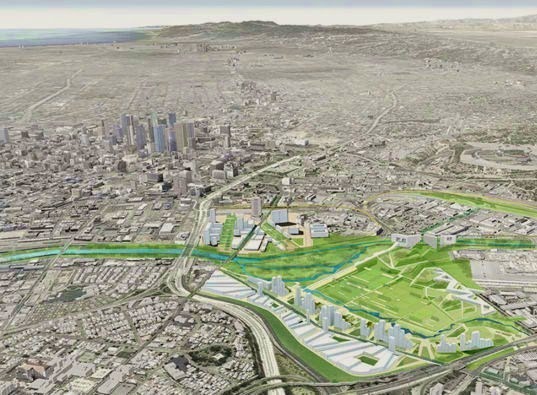
        Earlier this month federal regulators named the Los Angeles River a navigable waterway. That's given advocates for its restoration new hope for new projects. Here's more about one group's dream park near downtown Los Angeles.

        By Molly Peterson, KPCC 
        July 19, 2010

        From the roof of the sheriff's garage near downtown Los Angeles, the twin towers correctional facility is right next door. Dodger Stadium is visible, and as Lewis McAdams points out, "There's USC Medical Center on the east. There's Santa Fe brewery, the Metro maintenance facility. This is the only place people can actually see the Piggyback Yard."

        From this roof the Los Angeles River looks like a river. There's green algae along the bottom of it, red where metals are mixing in with it. The river is sort of hemmed in right now not only by the concrete but by rail tracks on either side of it.

        A train horn at the Union Pacific Transfer Yard sounds.

        I took in the rooftop view with Lewis McAdams of the Friends of the Los Angeles River. He wants to stoke excitement about a new park in central L.A. "What we set out to do was look at this railroad yard, which is over a hundred years old, which is the epitome of the industrial-era use of the river, which is basically a conveyance of goods and products... and imagine what this could become," McAdams says. "Its a chance, in a sense, to sculpt the future with water."

        A team of architects working with McAdams dreamed up dramatic changes for the L.A. River near this stretch – either diverting part of it onto spreading wetlands, or removing the east side of the river's concrete channel so that the water can meander. The project's hydraulic technical adviser, Ira Artz, says detaining some water on site would protect homes downriver from a major flood. "It actually reduces the amount of water that would otherwise go downstream in the channel and allows you to do more things with that channel. It shows what you can do by breaking out the channel, and that's very significant to both the Corps of Engineers, the county of Los Angeles and the city of Los Angeles," Artz says.

        Artz would know – he worked on the city-funded, $3 million L.A. River Revitalization Master Plan. That plan, says Leigh Christy from the architecture firm Perkins and Will, underpins Piggyback Yard.

        Christy says making a park people could get to on foot, on bikes or on rail lines could connect divergent neighborhoods. "Its very near downtown Los Angeles, very near where high speed rail is coming in," she says, "walking distance to Union Station, there are multiple things happening in this corridor right now. So there were a lot of opportunities to connect to transportation, to communities, to things like that."

        Christy's firm and three others met for eight months to conceptualize the park. Jessica Varner, an associate at Michael Maltzan Architecture, says their sketches were no holds barred.

        Architect Mark Salette says they've sketched out trails, soccer fields and gardens along the river. "We described it as a vertical integration of the uses as opposed to the way the city has developed horizontally and experienced a lot of segregation. I don't mean just from a racial standpoint but also from a use standpoint," he continues, "you have residential areas and industrial areas and office areas."

        Here and nearby they'd mix together multifamily housing, an arts center, stores, offices and warehouses – a stark contrast to the rows of containers parked at the Union Pacific Transfer Yard now. Landscape architect Mia Lehrer points over in that direction. "You see those trucks coming in there with the containers on the back?"

        Lehrer says Union Pacific's way of using the property now inspires the dream park's name. "The containers, they put it on a gurney and they get hauled to wherever. So it's piggybacking the containers as they move from the port and out of here," she says.

        The designers say they targeted Union Pacific's yard because of its size. A spokesman for the railroad confirms the company met with the team, but stresses that the property is integral to moving containers out of the port and into the west.

        Architects Mark Salette and Leigh Christy admit that's an obstacle – but argue it may not be a permanent one. "This yard is starting to be too small for the type of trains they want to assemble and they're doing a lot of it further east," he says.

        Christy breaks in. "Of course they said the land is not for sale. But they said that with the Cornfield and Taylor Yard too, so we hold out hope," she says with a smile.

        Those two parks took tens of millions of dollars, years, statewide initiatives, legislative action, lawsuits, and the largest multi-ethnic, multi-organization, multi-agency effort ever in L.A.'s history to happen. For this park Friends of the Los Angeles River isn't releasing a proposed price tag.

        Lewis McAdams says he knows he's an idealist. He's also a poet. "The poet William Carlos Williams said a new world is a new mind. So that's what we're doing, is creating a new mind," McAdams says.
        This week he starts making the rounds with city officials.

        Sunday, July 18, 2010

        Week Seven: San Simeon


        Hearst Castle

        Tiger skin rug love, I stroke, you bite me.
        Executive leather upholstered tightly
        .
        Bar in the next room, cocktails at seven
        .
        Soft lights, sweet music lounge through eleven
        .
        Let's walk in the garden, French windows open
        .
        Patio paving concrete and crazy
        roses in blossom,
        they're doing well this year
        .
        Geranium pattern shrub topiary
        .
        Lie on your lush lawns, waterfall bubbles

        Drink at my fountain, forget all your troubles.

        —Bryan Ferry, "San Simeon"

        Week 7
        M 7.19
        Optional class: Field trip to Henry Cowell Redwoods State Park. If interested, email me for details by Sunday night.

        W 7.21
        IN-CLASS
        Presentations (Chris, Vicky); Lecture—“How to do an Annotated Bibliography”

        DUE
        Persuasive essay, final draft (Attach draft 1)

        UPCOMING:

        Week 8
        M 7.26
        READ
        eR: “California: Ruined by the Supermajority” by Joe Matthews, “What’s the Matter with California?” by Robery Mackey and Liz Robbins, “Silicon Valley Loses Best-Workplace Luster After Job, Pay Cuts” by Ryan Flinn, “Fortune 500’s Flee California” by Michelle Steel, "

        IN-CLASS
        Reading discussion, Presentations; Preview—Editorial essay

        W 7.28
        READ
        eR: “The California Quagmire” by Karl Manheim, John S. Caragozian, and Don Warner, “Is Marijuana the Answer to California’s Budget Woes?” by Tom McNichol, "Cracks in the Future" by Bob Herbert, 'Why California is Still America's Future" by Michael Grunwald, “Californians Pessimistic about Future” from AirTalk, KPCV (audio program)

        IN-CLASS
        Writers workshop, Presentations

        DUE
        Editorial essay
        ; Research paper (Bring 3 copies of the first 2 pages of your paper)

        Thursday, July 15, 2010

        Will Michael Jackson's Neverland Ranch Become A State Park?

        By Allie Townsend, Time
        07.15.10


        A California legislator wants to make Neverland Ranch open to the public, but first, a broke California must foot the bill.

        California Assemblyman Mike Davis told the Associated Press that he's likely to propose a bill to the California State Senate for Neverland Ranch to become an official state park, controlled by the California Department of Parks and Recreation.

        Jackson, who signed over the estate to private equity firm Colony Capital LLC in 2008 amid money troubles, hadn't lived at Neverland since he was cleared of child molestation charges in 2005, but Davis argues this won't stop fans from making the pilgrimage from across the globe. At its peak, the 2,500-acre estate featured amusement park rides and a zoo and was the center of events the star held for children. There's no telling if the rides, cleared out after Jackson's death in 2009, would be reinstated on the estate's grounds, but if Davis gets his way, Neverland could be California's hottest new attraction, though without the singer's grave site, it would be a hard feat to trump Graceland.

        Given that the Governor Arnold Schwarzenegger had briefly supported closing 220 of California's 279 state parks to cut back on costs, it seems unlikely that the financially strapped state would be shopping for pricey real estate, but Davis says he'll move to propose a public-private partnership with Colony Capital. If the deal does go through, we wonder if Bubbles the chimp could get a job telling fortunes or something. Paul the octopus has retired, after all.